Best Wiki Software for Manufacturing and Engineering Operations
Discover how Docmost helps manufacturing and engineering operations centralize SOPs, work instructions, technical documentation, and team knowledge in one secure wiki.

TL;DR
- Manufacturing teams use wiki software to centralize SOPs, work instructions, maintenance procedures, engineering documentation, and quality manuals.
- A modern wiki improves collaboration, document control, and knowledge sharing across production, engineering, maintenance, and quality teams.
- Self-hosted wiki software gives organizations greater control over proprietary manufacturing knowledge and sensitive operational data.
- A wiki is not a quality management system or a PLM, and works best holding the procedures and troubleshooting knowledge that sit around those systems.
- Open-source platforms like Docmost, Wiki.js, BookStack, and MediaWiki offer flexible alternatives to proprietary documentation tools.
- The right choice depends on your documentation needs, collaboration requirements, and IT environment.
Walk through almost any manufacturing facility and you'll find documentation everywhere.
From standard operating procedures (SOPs) and maintenance manuals to quality checklists and engineering specifications, teams depend on reliable information to keep production running safely and efficiently.
Unlike general business documentation, manufacturing documentation directly affects production quality, equipment reliability, employee safety, and process consistency. Even the smallest documentation errors can lead to downtime, rework, or compliance issues. That's why manufacturing organizations often have different requirements when evaluating wiki software.
Yet, in many organizations, that information is spread across shared drives, paper binders, spreadsheets, email threads, and individual desktops. As documentation grows, finding the latest version becomes increasingly difficult. Engineers spend time answering the same questions, operators work from outdated procedures, and valuable knowledge leaves with experienced employees.
A manufacturing wiki provides a centralized, searchable workspace where teams can create, organize, and maintain documentation in one place. Instead of searching through multiple systems, everyone works from a single source of truth.
This guide explains why manufacturing and engineering organizations are adopting wiki software for manufacturing, what features matter most, how to choose the right platform, and the best solutions to consider.
Why Manufacturing and Engineering Teams Need Wiki Software
Production teams follow work instructions on the factory floor. Maintenance technicians rely on equipment manuals and troubleshooting guides. Engineers maintain process documentation and technical specifications, while quality teams manage inspection procedures and compliance records.
The challenge isn't creating documentation, it's keeping everyone aligned around the latest version.
As processes evolve, documents often become scattered across different storage locations. Some teams use shared folders, others rely on PDFs or spreadsheets, and important updates may only exist in email conversations or the knowledge of experienced employees.
Over time, that creates waste in four predictable places:
- Operators spend time searching for the right instructions instead of running the line.
- Maintenance teams duplicate work because previous solutions were never written down.
- Engineers answer the same recurring questions instead of improving processes.
- New employees take longer to become productive, because the knowledge they need isn't in a form they can find.
A wiki addresses these challenges by providing a shared workspace where documentation stays organized, searchable, and easy to update.
Rather than maintaining multiple copies of the same document, teams collaborate on a single version that's accessible to everyone with the appropriate permissions, which means more consistent operations, faster knowledge sharing, and greater confidence that employees are working from accurate information.
What to Look for in Manufacturing Wiki Software
Not every wiki is designed for manufacturing environments.
While ease of use is important, manufacturing and engineering teams should prioritize features that support operational consistency, secure collaboration, and long-term knowledge management.
- Version History
Manufacturing procedures change over time. When you update a machine setup guide or revise a safety procedure, version history makes it easy to track changes, review previous revisions, and restore earlier versions when needed.
- Powerful Search
Documentation only adds value if people can find it. So, a wiki should allow employees to quickly locate SOPs, maintenance procedures, equipment documentation, and engineering specifications without browsing through multiple folders.
- Detailed Permissions
Different teams often require different levels of access.
A good wiki lets administrators control who can view, edit, or manage specific documentation, helping protect sensitive engineering information while encouraging collaboration across departments.
- Real-Time Collaboration
Engineering, maintenance, and quality teams frequently contribute to the same documentation.
Real-time collaboration reduces duplicate work and keeps everyone working from the latest information.
- Self-Hosting Options
Many manufacturers prefer to keep operational documentation within their own infrastructure.
A self-hosted wiki provides greater control over proprietary processes, internal documentation, and sensitive business information while allowing organizations to integrate the platform with existing IT systems.
Document Control and What ISO 9001 Expects of Your Documentation System
If your facility is certified to ISO 9001, your documentation is already governed by a set of rules, whether or not the team thinks about it that way. Clause 7.5 covers what the standard calls documented information, and it applies the same way to a binder on a workbench as it does to a page in a wiki.
The standard is deliberately non-prescriptive about tools, so it won't tell you which software to buy. What it does require is that your documentation stays under control, and four of those requirements matter most when you're comparing platforms:
- Available and suitable for use where and when it's needed. A search and access problem before it's a storage problem.
- Protected against unauthorized change, loss, and improper use. A permissions problem.
- Changes controlled and the current revision identifiable. A version history problem.
- Obsolete versions not mistaken for current ones. The requirement shared drives fail most often and most quietly.
That last one is where audit findings come from. When a work instruction lives as a file, revising it produces a second file, and before long there's a copy on the shared drive, one on somebody's desktop, and one printed and taped inside a cabinet door with no way for an operator to tell which is the most current edition.
A wiki changes the shape of that problem, because there's one page at one address with its history visible, so when an auditor asks to see the current setup procedure for a line, you open the page and the page is the answer.
This is how the requirements line up against the wiki features you should be looking for:
|
Clause 7.5 Requirement |
What that looks like in a wiki |
|
Availability |
Full-text search, nested pages organized by line or asset, readable on a shop floor device |
|
Protection |
Space and page-level permissions, groups, read-only access for roles that shouldn't edit |
|
Change control |
Page history showing who changed what and when, with the ability to restore an earlier revision |
|
Obsolete versions |
A single canonical page rather than a folder of near-identical files |
|
External documents |
Attachments held alongside the procedure that references them, in storage you control |
It's important to note that a wiki is not a quality management system. It won't route a procedure through a signed approval chain, record that an operator was trained on revision E and acknowledged it, or force a periodic review when a document passes its expiry date.
If you need signed approvals and training attestation as retained records, that's QMS territory and a wiki won't replace it.
What a wiki does well is hold the knowledge a quality system was never built to hold: troubleshooting notes, machine quirks, changeover tips, the engineering thinking behind a specification, and the reason a tolerance sits where it does.
That material rarely makes it into a formal QMS, because updating a controlled document is tedious enough that nobody goes through it for an informal note. So plenty of manufacturers run both, keeping controlled records in the QMS and the working knowledge around them in a wiki, with each one linking to the other.
Teams in other regulated industries end up splitting their documentation the same way, and the mechanics look much the same in wiki software for financial services.
Self-hosting isn't a requirement of ISO 9001 and no auditor will ask for it. What it changes is the number of parties involved in the answer. When the documentation sits on infrastructure your IT team runs, questions about access control, retention, and encryption have answers you can demonstrate directly instead of relying on a vendor's attestations. That's a simpler audit conversation rather than a compliance obligation.
Export-Controlled Technical Data and Where It Can Live
If your shop does work for aerospace, defense, or their supply chains, part of your documentation carries legal restrictions on who is allowed to see it. Drawings, specifications, process sheets, test procedures, and tooling designs can all qualify as technical data under the International Traffic in Arms Regulations, and the moment that material lands in a wiki everyone at the company can read, you have an access problem rather than a documentation problem.
There's a widespread assumption in manufacturing IT that ITAR forbids the cloud and requires everything on premises. That hasn't been accurate since 2019. Under 22 CFR 120.54, storing or sending technical data isn't treated as an export when all of the following hold:
- The data is unclassified.
- It's protected by end-to-end encryption, applied before it leaves your security boundary and left in place until it reaches the recipient's.
- The encryption meets the standard the rule specifies, meaning FIPS 140-2 validated modules or equivalent.
- The means of decryption isn't provided to any third party.
- It isn't intentionally stored in a country the regulations prohibit.
That means cloud storage of controlled technical data is possible and plenty of defense suppliers do it. The bullets above are a summary rather than the rule itself, so read the regulation before relying on it.
So the case for keeping a wiki on your own infrastructure isn't that a regulation demands it. The case is that self-hosting shortens the argument you have to make. There's no vendor in the path, which means no reasoning about how a third party custodies encryption keys, where its regions actually are, or which of its support staff could reach the data during a troubleshooting session.
You define the boundary because you own it. The usual catch is, the encryption configuration, backups, and patching become your team's responsibility, and a badly configured self-hosted instance isn't compliant just because it's yours.
The more common mistake has nothing to do with hosting. If someone who isn't authorized can open the unencrypted file, that counts as an export whether the server sits in your building or in a data center on the other side of the world. Wikis are especially exposed here, because most start out being readable by everyone and stay that way.
Contract engineers arrive, temp staff get added during a busy period, colleagues at an overseas sister plant need one document and end up with a full account, and nobody goes back to check who still has access.
Four things help:
- Keep controlled technical data in its own space rather than scattered through general documentation.
- Grant access by group rather than through one-off page permissions.
- Close the space to default read access, so membership is deliberate.
- Review group membership on a schedule, the same way you'd review any other access list.
If you're documenting for a federal customer, the same reasoning shows up in audit form, which we covered in more detail in FedRAMP-ready documentation and why on-premises wikis matter.
And to state the obvious, none of the above is legal advice. Classification decisions and access determinations belong with your export compliance officer or counsel.
Why Shop Floor Documentation Breaks Most Wiki Software
Most wiki software is designed for someone sitting at a desk with a company laptop, a corporate network connection, and a browser they can leave open all day. Almost none of that describes an operator at a press mid-changeover, and it's the main reason documentation projects that look sound on paper go unused once they reach production.
Three things do most of the damage:
- The network.
Plant and OT networks are usually kept separate from the office network on purpose, and many have no connection to the internet at all. That makes a cloud-hosted wiki unreachable from the floor, which turns your single source of truth back into a printout somebody carried down from the office.
A self-hosted instance can sit where both sides reach it, or run entirely inside the plant network, which is one of the more practical arguments for self-hosted wiki software in an industrial setting rather than a philosophical one.
- The devices.
Nobody on the floor has their own laptop. Documentation gets read on shared screens at the workstation, on kiosks, and on tablets mounted at the line. If every worker has to log in individually at the start of a shift, people stop bothering within a couple of weeks, so it's better to set up one read-only account per station or per line and keep editing rights with the engineers and quality staff who own the content.
Remember too that pages get read standing up, in gloves, under bad lighting, with a machine down. Short pages with numbered steps and photographs work far better than long prose.
- The structure.
An operator troubleshooting a specific machine doesn't know which department owns the procedure, and shouldn't have to. Organize the wiki around the equipment instead, so each page sits under the line, cell, or machine it describes.
If you run more than one site, give each plant its own space and keep the standards everyone shares in a space above them. That way a plant can hold its own equipment documentation without having to copy and edit the company procedures it works from.
Self-Hosted vs. Cloud Wiki Software for Manufacturing
The three sections above cover the situations where self-hosting matters most: proving to an auditor which version of a procedure is current, keeping restricted drawings on equipment you own, and putting the wiki somewhere the floor can actually reach it.
Outside those situations, the choice is more straightforward.
Cloud platforms are faster to start with. The vendor runs the infrastructure, applies updates, and handles backups, so a smaller manufacturer with no one to look after internal software can have a working wiki in an afternoon.
Self-hosting gives you the control the sections above describe, and in return your IT team takes on the servers, backups, upgrades, and security patching.
If they already look after internal systems, that will be familiar work for them. If they don't, it's a real commitment you should plan towards.
Here's the clean, full version — duplicate removed, closing de-salesed, and pricing excluded (including the dangling references to it in the "good fit" section, so nothing feels unexplained):
The Best Wiki Software for Manufacturing and Engineering Operations
After looking at what manufacturing teams need, the answer to "best engineering wiki" comes down to: choosing a platform that matches how engineering and operations teams actually work.
Manufacturing documentation changes constantly. Procedures improve, maintenance teams discover better fixes, quality requirements evolve, and engineering standards are refined over time. A documentation platform has to make those updates easy while keeping everyone working from the latest version and for a lot of manufacturers, it also has to stay on infrastructure they control, since SOPs and process documentation can be commercially sensitive.
Docmost is an open-source, self-hosted wiki and documentation platform. It's built as a Confluence-style alternative for teams that want real-time collaborative editing but don't want their documentation living on someone else's servers. You can run it as a free, self-managed Community edition, or add Business or Enterprise tiers that layer on things like SSO and AI search on top of the same self-hosted foundation.
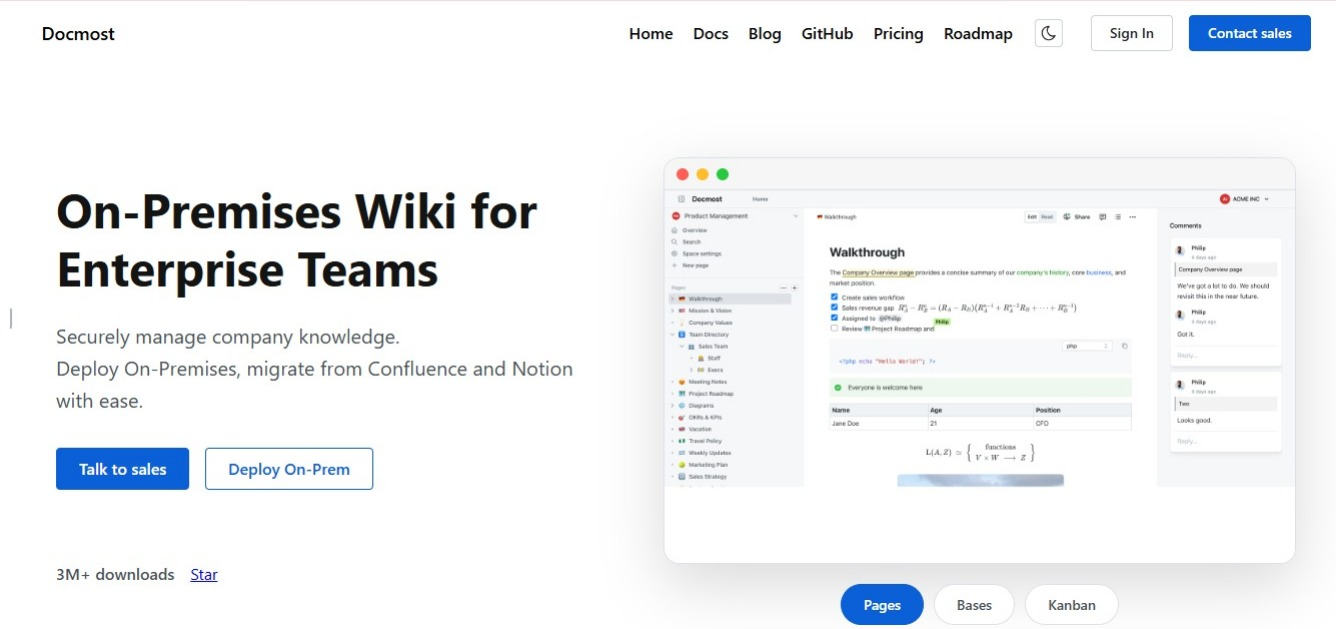
Rather than scattering SOPs, work instructions, troubleshooting guides, maintenance procedures, and engineering documentation across shared folders and disconnected systems, teams can maintain everything in one searchable workspace, deployed via Docker on infrastructure IT already controls.
Features that make Docmost well-suited for manufacturing and engineering operations include:
- Real-time collaboration for updating procedures and documentation together.
- Version history to track changes and restore previous revisions when needed.
- Powerful search to quickly locate SOPs, work instructions, maintenance guides, and engineering documentation.
- Spaces to organize documentation by department, facility, production line, or project.
- Markdown and rich-text editing for creating both simple notes and detailed technical documentation.
- Diagrams and file attachments to support visual documentation, equipment layouts, and process workflows.
- Flexible self-hosting on your own infrastructure.
Those capabilities address the practical challenges covered throughout this guide: keeping procedures current, making documentation easy to find on the shop floor, protecting sensitive engineering knowledge, and building a single source of truth that evolves alongside your production processes.
Who it's a good fit for
Teams running lean with a small core group can start on Community and get real value immediately, with no setup cost beyond hosting it themselves. Larger manufacturers with multiple facilities, compliance requirements, or a need for SSO and audit trails will want Business or Enterprise, which build on the same foundation with more control and integration built in. Either way, the entry point is low enough to try it on a single production line or department before rolling it out wider.
If your goal is replacing scattered documentation with a single, easy-to-maintain source of truth, Docmost is worth putting on your shortlist.
Frequently Asked Questions
- What is a manufacturing wiki?
A manufacturing wiki is a shared, searchable place for the documentation a plant runs on: work instructions, SOPs, equipment manuals, troubleshooting notes, engineering specifications, and quality and safety procedures. What makes it different from a general company wiki is that some of it is controlled and needs a revision trail, the rest is informal knowledge, and all of it has to be readable from the floor.
- How is a wiki different from a document management system?
A document management system (DMS) is built around files. A wiki is built around pages people edit in place, which suits documentation that changes often and has several authors. In practice the DMS holds the approved drawing, and the wiki holds the procedure explaining how to work to it. Plenty of manufacturers run both.
- Can a wiki satisfy ISO 9001 document control on its own?
Partly. Page history, enforced permissions, and visible revision status cover what clause 7.5 asks for. What a wiki won't do is route signed approvals, record that a named operator was trained on a specific revision, or force a review at a deadline. If your quality system needs those as records, keep them in the QMS and use the wiki for everything around them.
- How does a wiki fit alongside our ERP, MES, or PLM?
They hold different things. PLM owns part and product data, MES owns execution records, ERP owns transactions. A wiki holds the explanation around them: the procedures, the troubleshooting knowledge, the reasoning behind a decision. A wiki page describes how and why, then links to the authoritative record in whichever system governs it.
- Do we still need printed work instructions at the workstation?
Often yes. The risk isn't the printout, it's the printout nobody replaces. Print the revision number and date on every copy, reissue when the procedure changes, and keep the wiki page as the only master. Audit findings come from the unofficial copy in a drawer, not from paper itself.
Bringing Manufacturing Documentation Into One Place
The difference between a documentation system that works and one that doesn't usually comes down to three things: whether an auditor can see which revision governs, whether restricted drawings stay where you can account for them, and whether an operator can open the right procedure without walking back to the office. Most wiki software answers one of those well and ignores the other two.
Docmost is built to address all three. It runs on your own infrastructure with Docker, keeps a complete revision history for every page, and lets you control access by group at the space level. That means the same platform can securely house both your controlled work instructions and the troubleshooting knowledge that accumulates around them.
You can deploy it yourself in an afternoon if your team already manages internal applications, or talk to us about what a plant-wide rollout could look like.